

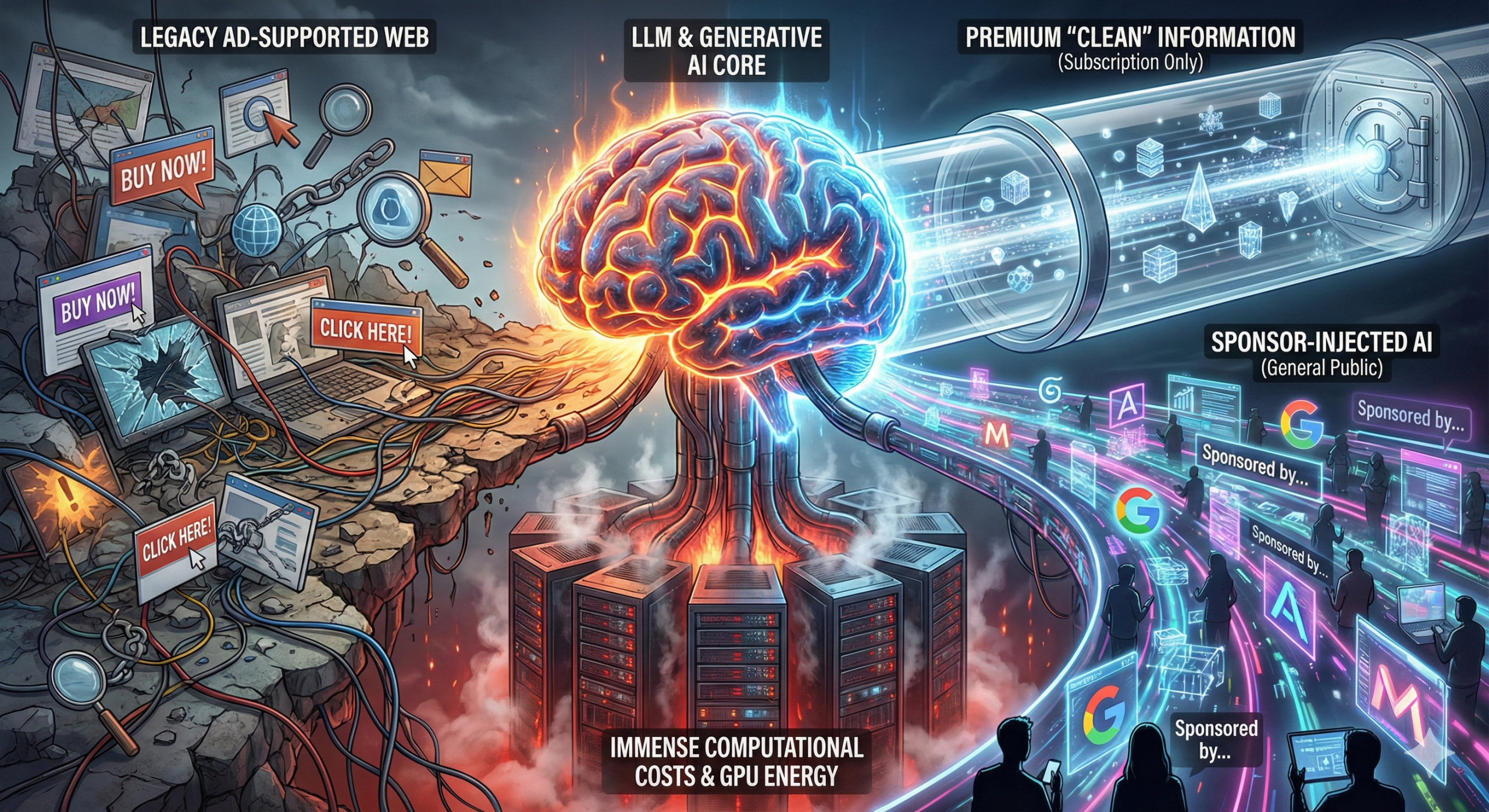

The global digital ecosystem would likely face its most transformative decade as Large Language Models (LLMs) and generative artificial intelligence redefine the basic mechanics of information retrieval. For nearly thirty years, the “free” internet has been sustained by a precarious social contract: users surrender their data and attention in exchange for access to knowledge. However, the rise of sophisticated AI models – ranging from OpenAI’s GPT series and Anthropic’s Claude to Google’s Gemini and Meta’s Llama – would likely render the traditional ad-supported web obsolete. As these models become the primary gateways to information, the necessity of navigating through ad-cluttered websites would significantly diminish. This evolution would likely force a transition toward new monetization strategies, potentially creating a world where “clean” information becomes a premium commodity.
The Economic Realities of Large Language Models
The transition to an AI-driven internet would likely be dictated by the immense computational costs associated with generating intelligence. Unlike traditional search indexing, which is relatively inexpensive to maintain, running complex AI models requires vast GPU resources and energy. Consequently, the “free” model that dominated the early 21st century would likely become unsustainable in its current form.
If the cost of a single AI-generated answer remains significantly higher than a standard search query, technology companies would likely be forced to seek immediate revenue. This would likely result in two parallel paths: the aggressive expansion of subscription-based “Premium” AI and the development of “Sponsor-Injected” AI for the general public. Thus, the probability of a truly ad-free internet for all users remains low, although the nature of the advertisements themselves would likely change beyond recognition.
The Emergence of the Two-Tier Digital Experience
The digital landscape would likely bifurcate into a two-tier system, fundamentally altering societal access to information. This “digital stratification” would likely be defined by a user’s financial capacity to opt out of commercial influence.
Potential Characteristics of the Bifurcated Internet:
-
The Premium Knowledge Tier: High-paying subscribers would likely enjoy access to “Pure AI” models. these systems would likely be optimized for objective truth, data integrity, and high-level reasoning, completely free from commercial bias or sponsored recommendations.
-
The Ad-Supported Assistant Tier: The majority of users would likely interact with free or low-cost AI models. These assistants would likely be highly capable but would subtly integrate brand-aligned suggestions and sponsored content directly into their conversational flow.
-
The Data Privacy Divide: Premium users would likely benefit from enhanced data privacy, where their queries are not used for targeted advertising. In contrast, free-tier users would likely continue to “pay” with their behavioral data, which would be used to train even more persuasive AI agents.
The Transformation of Advertising into AI-Driven Recommendations
In a world where AI models provide direct answers, the concept of a “banner ad” or a “sponsored link” would likely become an ancient relic. Instead, commercial influence would likely be woven into the very logic of the AI’s response. This shift would likely move the industry from “Cost-Per-Click” (CPC) to a more insidious “Cost-Per-Recommendation” (CPR) model.
If an individual were to ask an AI model for a complex solution – such as a legal strategy or a home construction plan – the AI would likely suggest specific service providers as part of its “expert” advice. This would likely be perceived not as an advertisement, but as a helpful, objective recommendation. Consequently, the challenge for companies would no longer be to rank in search results, but to be “learned” by the AI as the most authoritative and trustworthy option in a given field.
“The ultimate monetization of artificial intelligence would likely not be the sale of products, but the sale of influence over the decision-making process itself.”
Subscription Fatigue and the Inevitability of Commercial Influence
While the demand for ad-free information would likely grow, the probability of widespread adoption would likely be hindered by “subscription fatigue.” Consumers already face a fragmented landscape of streaming, cloud, and productivity subscriptions. Adding a significant monthly fee for high-level AI access might be a barrier that only a fraction of the population would be willing to overcome.
Factors Influencing the Persistence of Ads:
-
Infrastructure Scaling: As AI models become more ubiquitous, the energy requirements would likely keep the operational costs high, making advertising revenue a necessary evil for mass-market availability.
-
Corporate Subsidies: Many “free” AI models would likely be subsidized by corporations that want to use the AI as a sophisticated top-of-the-funnel lead generation tool.
-
The “Good Enough” Threshold: Most users would likely find the ad-supported AI “good enough” for daily tasks, reserving paid subscriptions only for professional or high-stakes inquiries.
Therefore, the internet would likely not become ad-free, but rather “ad-transformed.” The commercial influence would likely move from the periphery of the screen into the center of the cognitive experience.

The Hidden Influence in Training Data
Even in the most expensive, “ad-free” subscription models, absolute objectivity would likely remain an elusive goal. The probability of “algorithmic bias” would likely persist because the AI models are trained on the existing internet – a space already saturated with commercial interests.
If a specific brand or industry dominates the high-quality data used to train an LLM, the model would likely “naturally” prefer that brand’s philosophy or products. This “Invisible Marketing” would likely be the most difficult form of influence to detect. Companies would likely spend billions ensuring that their data is the most accessible and “correct” for AI crawlers, effectively buying their way into the AI’s foundational knowledge without ever paying for a direct ad.
Strategic Shifts for Information Providers
As AI models consolidate their role as the primary interface for the internet, those who provide information – from news organizations to specialized experts – would likely need to reinvent their value proposition.
A Roadmap for the AI-First Era:
-
Direct-to-Consumer Relationships: Information providers would likely prioritize building private communities and email lists to maintain a direct link to their audience, bypassing AI gatekeepers.
-
Verified Authority: To avoid being “summarized into irrelevance,” creators would likely focus on providing unique, first-hand experiences and “Information Gain” that AI cannot easily replicate.
-
Data Licensing Agreements: Large publishers would likely move toward a model where they are paid by AI companies for access to their high-quality, real-time data, effectively shifting their revenue from ads to licensing.
-
Specialized Expert Models: We would likely see the rise of niche AI models trained on specific, high-integrity datasets (e.g., medical or legal) that offer a higher level of trust than general-purpose LLMs.
The future of digital information access would likely not be a simple choice between ads and no ads. Instead, it would likely be a complex, hybrid ecosystem where the cost of intelligence is paid through a variety of means. While AI models would likely offer the possibility of a cleaner, more efficient internet experience, they would also likely introduce more subtle and powerful forms of commercial influence. The “ad-free” internet would likely become a luxury for those who can afford it, while the rest of the world interacts with an AI that is both a brilliant assistant and a highly optimized salesperson. Ultimately, the value of information would likely be measured not by its availability, but by the transparency and integrity of the model that provides it.