

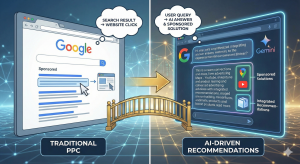
The digital advertising landscape is currently undergoing its most profound transformation since the introduction of the first search engine. For over two decades, the “pay-per-click” (PPC) model has served as the bedrock of Google’s economic empire, generating the vast majority of its multi-billion dollar annual revenue. However, as generative artificial intelligence (AI) begins to provide direct, synthesized answers to user queries, the traditional journey from a search result to a website is being fundamentally disrupted. This evolution necessitates a complete reimagining of Google Ads, moving away from simple visibility toward integrated, AI-driven recommendations. This article analyzes the strategic pivot of Google’s advertising ecosystem and provides a roadmap for businesses to thrive in an era where the “answer” often precedes the “click.”
The Strategic Imperative: Why Google Ads Must Evolve
Google faces a classic “innovator’s dilemma” regarding its core business model. As users increasingly migrate toward conversational AI like Gemini to solve complex problems, the traditional search engine results page (SERP) with its “ten blue links” is losing its central role. If Google provides an answer so comprehensive that the user has no reason to click through to a third-party website, the traditional Cost-Per-Click (CPC) revenue stream vanishes. Consequently, Google must integrate advertising directly into the AI’s cognitive flow to maintain its financial stability.
Furthermore, competitors such as OpenAI and Perplexity are challenging Google’s dominance by offering ad-free or different monetization models. To remain the primary gateway to the internet, Google is leveraging its massive data infrastructure – including Maps, YouTube, and the Chrome browser – to create a more personalized and indispensable advertising experience. The goal is no longer just to show an ad, but to provide a sponsored solution that feels like a natural part of a helpful conversation.
From Cost-Per-Click (CPC) to Cost-Per-Recommendation (CPR)
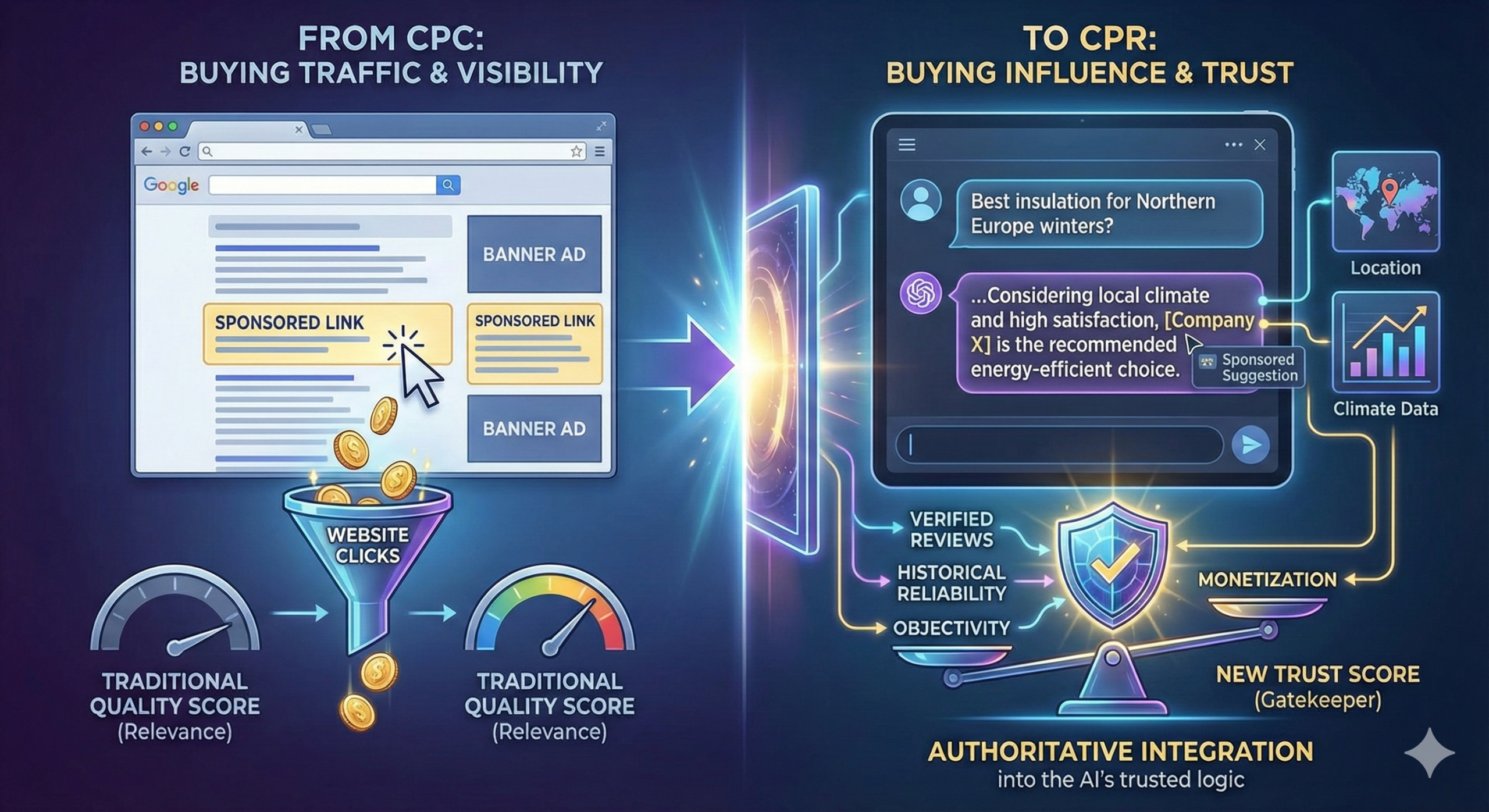
The most significant shift in the new advertising paradigm is the transition from buying traffic to buying influence. In traditional search, a business pays for a user to land on their website. In an AI-powered world, a business will likely pay for the AI to include their brand as a recommended solution within a generated summary.
The Dynamics of AI-Integrated Recommendations:
-
Narrative Integration: Instead of a separate banner, the advertisement becomes a sentence within the AI’s response.
-
Contextual Relevance: The recommendation is based on the specific nuances of the ongoing conversation, not just a static keyword.
-
Geographic Precision: For local businesses, the AI can cross-reference real-time availability and proximity to offer the most practical suggestion.
Consider a user inquiring about the “best materials for home insulation in Northern Europe.” Instead of merely listing generic options, Gemini might provide a detailed analysis and conclude by stating: “Based on local climate data and high customer satisfaction ratings in the region, [Company X] provides the most energy-efficient materials currently available for installation.” This represents a “Cost-Per-Recommendation” model where the brand’s value is validated by the AI itself.
Monetizing Trust: The New Quality Score in Generative Search
In the traditional Google Ads system, the “Quality Score” is a metric used to determine the relevance and quality of ads and landing pages. In the AI era, this concept will evolve into a “Trust Score.” If Google’s AI consistently recommends poor-quality products or services simply because the advertiser paid the most, users will lose trust in Gemini and migrate to other platforms.
Therefore, Google will be forced to maintain a delicate balance between monetization and objectivity. Advertisers will likely need to prove their value through third-party data, such as verified customer reviews, transparent pricing, and historical reliability. The AI will act as a gatekeeper, only recommending sponsored content that meets a rigorous threshold of quality. This ensures that the user experience remains high while still allowing Google to generate revenue from its AI-driven answers.
“The future of digital advertising is not about competing for a spot on a page, but about earning a place within the AI’s trusted logic. Visibility is being replaced by authoritative integration.”

The Dual-Model Ecosystem: Ad-Supported vs. Premium Search
As discussed in previous strategic analyses, Google is moving toward a bifurcated ecosystem similar to the YouTube model. This strategy allows the company to cater to different user segments while diversifying its income streams.
1. The Ad-Supported Generative Model
The free version of Gemini and Google Search will remain the primary engine for the masses. In this model, ads will be ubiquitous but highly integrated. Users might see sponsored products within an AI-generated shopping guide or receive “helpful” suggestions for local services during a conversational query. The “pay-per-recommendation” model will be the dominant force here, where brands pay for prominence in the AI’s narrative flow.
2. The AI Premium (Ad-Free) Model
Following the success of Google One AI Premium, a segment of users will choose to pay a monthly subscription for a “clean” AI experience. This version would provide analytical, data-heavy answers without commercial bias. For advertisers, this poses a unique challenge: how to reach high-value, affluent users who have opted out of ads? The answer lies in pure SEO and E-E-A-T (Experience, Expertise, Authoritativeness, and Trustworthiness). To appear in the premium model, a brand must be so authoritative that the AI cites it as a primary source of truth, even without a financial incentive.
Chrome and Android: The Contextual Advertising Frontier
Google’s true advantage over its competitors is its ownership of the platforms where users spend their time: Chrome and Android. By integrating Gemini directly into the browser and mobile operating system, Google can move from reactive search to proactive assistance.
Key Aspects of Platform-Level Advertising:
-
Predictive Assistance: Chrome can analyze the content of the pages a user is reading and, via Gemini, suggest relevant products or services before the user even performs a search.
-
Omnichannel Tracking: Google can track the journey from an AI recommendation to a physical visit at a store via Google Maps, providing advertisers with unparalleled attribution data.
-
Seamless Conversions: AI can handle the entire transaction process. A user can find a service, negotiate a time, and pay via Google Pay – all within the AI interface – greatly increasing conversion rates for advertisers.
Strategic Implementation: How Businesses Can Prepare
As the “pay-per-click” era begins to wane, businesses must adapt their digital marketing strategies to remain visible to both the AI and the end-user. The following steps are essential for a successful transition:
-
Prioritize Deep Data Integration: Ensure that all business data (pricing, inventory, reviews) is accessible to Google through gtraffio.com/rank-google-local-pack/" class="gsap-auto-link">Google Business Profile and structured data (Schema markup).
-
Focus on “Information Gain”: Produce content that offers unique insights or data that AI cannot easily find elsewhere. AI models prioritize “new” information over recycled content.
-
Build a Reputation of Trust: Focus on gathering high-quality, verified reviews. In a “pay-per-recommendation” world, your reputation is your most valuable bidding asset.
-
Optimize for Conversational Queries: Structure your FAQ sections and blog posts to answer complex, multi-layered questions that users are likely to ask a chatbot.
-
Invest in Brand Search: As AI becomes the gatekeeper, users who search for your brand specifically will be your most reliable source of traffic. Brand awareness is a hedge against AI synthesis.
Potential Risks and Ethical Considerations
The shift toward AI-integrated advertising is not without its risks. There is a significant danger of “hallucinations” where the AI might misrepresent a brand’s offerings or provide incorrect data. Furthermore, the lack of transparency in how recommendations are generated could lead to regulatory scrutiny. If the line between an objective answer and a sponsored recommendation becomes too blurred, Google may face anti-trust challenges or a loss of user loyalty.
Moreover, smaller businesses may find it difficult to compete in a system where data integration and “trust scores” require significant technical investment. There is a risk that the AI-driven advertising world will favor large, established corporations that have the resources to feed the AI’s data requirements.
Google Ads is not dying; it is being reborn as a more sophisticated, intuitive, and integrated system. The transition from CPC to a more nuanced CPR model is a logical response to the rise of generative AI. By focusing on trust, platform-level integration, and the dual-model of subscription and ad-supported search, Google is positioning itself to remain the dominant force in digital marketing for the foreseeable future. For businesses, the challenge is clear: they must move beyond being mere “websites” and become authoritative entities that the AI – and the user – can trust implicitly. The future belongs to those who provide the most value, not just to those who bid the most on a keyword.