



The digital marketing landscape is currently experiencing its most significant transformation since the inception of the World Wide Web. As search engines evolve from simple indexers into sophisticated cognitive assistants, the discipline of Search Engine Optimization (SEO) must undergo a fundamental shift. Google, a company that derives over 70% of its total revenue from search-related advertising, finds itself at a critical juncture. It must balance technological innovation with the preservation of its lucrative business model. The introduction of Gemini, Google’s most capable multimodal AI, represents a decisive response to the rise of generative AI competitors. This article provides a deep analysis of how AI integration, changing user habits, and evolving monetization strategies will define the future of search.
Defining the New SEO Landscape: From Keywords to Intent
For decades, SEO was primarily concerned with matching specific keywords to webpage content. This era of “exact match” optimization is rapidly concluding. Modern search engines now prioritize semantic understanding and user intent over mere linguistic repetition. Google Gemini utilizes advanced neural networks to comprehend the nuanced context of a query. It no longer views search terms in isolation. Instead, it interprets the relationship between concepts.
Consequently, the focus of content creation must shift toward topical authority. A successful strategy involves creating comprehensive clusters of information that address every facet of a subject. This approach ensures that the search engine recognizes the website as a reliable source of truth. Furthermore, the rise of conversational search requires content that mirrors natural human inquiry. Users are no longer typing fragmented phrases; they are asking complex questions.
The Strategic Advantages of AI Integration in Search
The integration of Gemini into the Google ecosystem offers unprecedented efficiency for the end-user. By processing information from diverse sources—including YouTube, Google Maps, and indexed web pages—the AI provides synthesized answers. This multimodal capability allows for a more intuitive search experience. For instance, a user can now search using images, video, and text simultaneously.
Moreover, AI integration allows for hyper-personalization. The search engine can tailor results based on the user’s previous interactions and current context. This level of relevance was previously unattainable through traditional algorithmic sorting. From a strategic perspective, this means that high-quality, relevant content will be more accurately matched with the intended audience. The efficiency of information retrieval is significantly enhanced, leading to a more streamlined user journey.

Potential Risks and Strategic Considerations for Publishers
Despite the technological advancements, the shift toward AI-driven search poses significant risks for traditional publishers. The most prominent concern is the rise of “zero-click” searches. This occurs when the Search Generative Experience (SGE) provides a complete answer directly on the results page. Consequently, the user has no incentive to click through to the original source. This phenomenon threatens the traffic volumes that many digital businesses rely on for survival.
Furthermore, there is a risk of brand dilution. When AI synthesizes content from multiple sources, the individual voice of a publisher can become obscured. Organizations must consider how to maintain their unique identity within an AI-generated summary. There are also legal and ethical considerations regarding data usage. Publishers are increasingly concerned about their intellectual property being used to train the very models that may eventually replace their traffic.
Selection Guide: How to Adapt to the AI Era
Adapting to the future of SEO requires a deliberate and multi-faceted approach. Digital marketers must choose strategies that prioritize long-term resilience over short-term gains. The following criteria are essential for navigating this transition:
Prioritizing E-E-A-T (Experience, Expertise, Authoritativeness, and Trustworthiness)
Google’s focus on E-E-A-T is more critical than ever. AI can generate text, but it cannot replicate genuine human experience. Content that features first-hand accounts, original research, and expert analysis will remain highly valued. It is imperative to demonstrate “Information Gain” by providing insights that are not already present in the AI’s training data.
Optimizing for Answer Engine Optimization (AEO)
To stay relevant, content must be structured to be easily “digestible” by AI models. This involves using clear headings, concise definitions, and structured data. If a website becomes the primary source for an AI-generated summary, it maintains its relevance in a zero-click environment. AEO is the necessary evolution of traditional SEO practices.
Leveraging Multimodal Content
As search becomes multimodal, SEO strategies must expand beyond text. Investing in high-quality video, audio, and visual assets is essential. Gemini’s ability to “see” and “hear” means that metadata for non-textual content is more important than ever. A diversified content portfolio ensures visibility across all search formats.
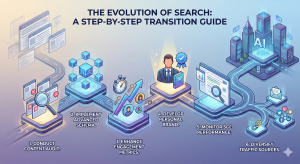
The Evolution of Search: A Step-by-Step Transition Guide
Navigating the shift toward an AI-centric search environment requires a systematic approach. Organizations should follow this logical progression to ensure their digital presence remains robust:
-
Conduct a Content Audit: Evaluate existing pages to identify which are most vulnerable to being replaced by AI summaries.
-
Implement Advanced Schema Markup: Use technical SEO to explicitly define the relationships between different entities on your website.
-
Enhance User Engagement Metrics: Focus on dwell time and interaction rates, as these signal to Google that your content provides value beyond a quick AI answer.
-
Develop a Personal Brand: Invest in recognizable authors and experts whose names carry weight and authority in their respective fields.
-
Monitor SGE Performance: Regularly track how your brand appears in generative search results and adjust your formatting accordingly.
-
Diversify Traffic Sources: Reduce dependency on organic search by building email lists, social media communities, and direct referral networks.
Common Pitfalls in AI-Era SEO and How to Avoid Them
Many organizations make the mistake of attempting to “out-produce” AI. Generating massive amounts of low-quality, AI-assisted content is a strategy destined for failure. Google’s algorithms are increasingly adept at identifying and devaluing content that lacks substance. Another common error is neglecting technical SEO. While the “front-end” of search is changing, the “back-end” requirements for site speed and crawlability remain vital.
Furthermore, ignoring the human element is a significant oversight. Users still crave connection and authenticity. Content that is overly clinical or clearly automated will struggle to build a loyal audience. It is also a mistake to ignore the emerging advertising models. Marketers must stay informed about how sponsored content will be integrated into AI responses to ensure their brands remain visible.
“The true value of SEO in the age of artificial intelligence lies not in the manipulation of algorithms, but in the creation of indispensable human value that AI can reference but never replace.”
Future Trends: Monetization, Gemini, and the Chrome Ecosystem
Google’s primary objective is to safeguard its advertising revenue. We can anticipate several key trends in how AI will be integrated into the economic fabric of the web. Firstly, the “YouTube Model” of subscription is likely to expand. We may see a clear distinction between a free, ad-supported AI search experience and a premium, ad-free version.
Secondly, the Chrome browser will likely become the primary interface for AI interaction. By embedding Gemini directly into the browser, Google can offer real-time assistance across every website a user visits. This creates new opportunities for “contextual advertising,” where ads are served based on the specific task a user is performing in their browser. Lastly, the rise of “Action-Oriented Search” will allow users to complete transactions – such as booking a flight or purchasing a product – directly within the search interface. This will shift the focus of SEO from driving clicks to driving conversions within the Google ecosystem.
The future of SEO is not a decline, but an evolution toward greater sophistication. While the dominance of Google Gemini and the rise of the Search Generative Experience present challenges, they also offer opportunities for those who prioritize quality and authority. Google’s reliance on advertising revenue ensures that the search ecosystem will remain a vital marketplace for information and commerce. However, the methods of participation must change.
Success in this new era requires a commitment to E-E-A-T, a mastery of Answer Engine Optimization, and a willingness to adapt to new monetization models. Digital marketers must transition from being “search engine optimizers” to becoming “audience experience strategists.” By focusing on providing unique human insights and technical excellence, businesses can thrive in the AI-driven landscape. The goal is to remain the authoritative source that both humans and AI models trust implicitly.