



Ever pour your absolute soul into building a drop-dead gorgeous online storefront, only to hit “publish” and be met with a deafening silence? Oh, I have lived that nightmare. It happens to the best of us. When we initially plunge headfirst into the chaotic, thrilling universe of e-commerce, pouring every ounce of creative juice into a flashy homepage feels like the natural thing to do. But here is a gnarly little truth I stumbled upon while battling my way to SEO proficiency: your product and category pages are the real heavy lifters. They act as the digital aisles. The window displays. The exact spots where a wandering window-shopper suddenly morphs into a paying, loyal buyer.
To funnel a relentless stream of high-converting, organic traffic into our digital shops, we must spoon-feed search engines precisely what we are peddling. No ambiguity. Today, I am unpacking my absolute favorite tactics for supercharging those vital product and category hubs. Grab a mug of whatever fuels you. Let’s get those rankings climbing!
Mastering Your Category Pages
Picture your category pages as massive, neon signposts inside a sprawling, labyrinth-like mall. If a guy is hunting for “Men’s Running Shoes,” he doesn’t want to wade through a sea of winter parkas to get there. Guess what? Google’s bots feel the exact same way. These pages demand ruthless structure. They must be hyper-relevant. Ridiculously easy to digest.
First up: keyword reconnaissance. For category hubs, I always cast a wider net, targeting broader, chunky-volume search terms. Found that golden keyword? Great. Now, weave it effortlessly into your URL, the meta title, and that crucial meta description snippet. Keep those URLs razor-sharp and logical think /mens/shoes/running rather than a chaotic jumble of random digits and symbols.
Next, we actually need to inject some words into these spaces. A catastrophic blunder I routinely spot? Store owners abandoning category pages as barren, textless grids of product photos. Search algorithms crave context! Do yourself a massive favor: draft a punchy, magnetic introductory blurb to sit either at the top or the very bottom of the grid. Brag about what makes this specific collection sing. Highlight a standout feature or two, and sprinkle in those target phrases. But keep it breezy. We write for breathing humans first, cold algorithms second. Always.
Perfecting Your Product Pages
Let’s pivot to the undisputed rockstars of your store: the individual product pages. This is the arena where the real alchemy happens. Where our gritty optimization tweaks can literally salvage or tank a sale. Landing on a product page generally means a shopper has plummeted to the very bottom of the buying funnel. Their credit card is likely hovering near the keyboard. We just need to give them that one final, gentle nudge.
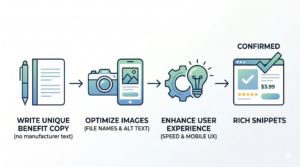
Here is the absolute, unbreakable golden rule of product SEO. Never and I mean absolutely never copy-paste the manufacturer’s stock description. If you lazily slap up the exact same boilerplate text as five hundred rival retailers, Google will instantly flag it as duplicate filler and your page will become a ghost. Instead, roll up your sleeves and craft fiercely unique, persuasive copy. Zero in on the visceral benefits, rather than just rattling off dry features. How does this gadget or garment genuinely improve a buyer’s Tuesday? How does it solve a nagging headache?
Don’t underestimate the visual payload, either. We need crisp, blazing-fast imagery. But wait! Before you casually upload that photo, strip away the default IMG_1234.jpg gibberish. Rename the file to something hyper-specific, like blue-ceramic-coffee-mug.jpg. And please, for the love of rankings, staple a descriptive alt-text tag onto every single image. Search engines are blind; you have to paint the picture for them.
E-commerce SEO extends far beyond merely chasing keyword rankings; it is about bridging a searcher’s raw, underlying intent with a buttery-smooth buying journey. If a product page fails to address a shopper’s unspoken objections, no avalanche of traffic will rescue your conversion rate.
Don’t Forget the Technical Touches

While punchy prose and stunning photography are non-negotiable, ignoring the under-the-hood technical mechanics is a death wish. One of the most fiercely potent weapons in an SEO arsenal? Schema markup. Specifically, Product schema. Injecting this invisible snippet of code into your backend spoon-feeds Google the juicy details – price, stock availability, and those coveted user reviews – directly on the search results page. Ever noticed those glaring gold stars shining on a Google query? That is Schema flexing its muscles, and it sends click-through rates through the absolute roof.
Lastly, User Experience (UX) cannot take a backseat. A sluggish, bloated product page guarantees an abandoned cart. Period. I obsessively compress my image files and rigorously test my theme to ensure it bends beautifully across mobile devices. Because let’s face reality: the vast majority of your buyers are thumbing through your shop on a smartphone while waiting in line for coffee. If your site stutters on a small screen, they are gone.
Frequently Asked Questions
How long should my product descriptions be?
I typically shoot for the 250 to 300-word sweet spot when drafting standard product copy. But honestly? The real answer hinges entirely on what exactly you are selling. A basic cotton v-neck might only demand a brisk paragraph paired with a punchy bulleted list of fabric specs. Conversely, a high-end mirrorless camera requires a deep, exhaustive explanation to appease both meticulous tech nerds and content-hungry search spiders.
Is it ever okay to use the manufacturer’s product descriptions?
I strongly, vehemently advise against this. Leaning on canned manufacturer copy triggers massive duplicate content headaches. Basically, you end up locked in a pointless SEO battle against the manufacturer themselves – plus every other notoriously lazy retailer slinging the exact same widget. Crafting your own vibrant, bespoke copy hands you an undeniable edge. Plus, it lets your brand’s quirky, unique personality actually bleed through the screen.
What is schema markup, and why do I need it?
Think of schema markup as a behind-the-scenes translator – a chunk of structured data woven into your site’s DNA that helps search algorithms spit out richer, more detailed results. In the e-commerce realm, it is the secret sauce that unlocks “Rich Snippets.” This means your live price, inventory status, and glowing review stars actually show up right there on Google. It forces your listing to visually pop, skyrocketing your odds of earning that click.
How many keywords should I target per category page?
I am a huge advocate for laser focus. Pin down one robust primary keyword per category page (think something like “Women’s Leather Handbags”). Then, sprinkle in two or three closely tethered semantic variations (maybe “Genuine Leather Purses for Women”). Attempting to forcefully cram six different, barely-related concepts into a single category layout will only bewilder Google’s bots and severely water down your ranking juice.