



I can pinpoint the exact second the SEO world completely lost the plot. Late 2022. The floodgates of generative AI didn’t just open; they were kicked off their hinges. Overnight, the age-old mantra of “content is king” morphed into a frenzied “AI content is infinite.” I stood by watching colleagues, bitter rivals, and massive media conglomerates gut their writing departments. Their replacements? Dirt-cheap API calls. Automated prompt chains. They genuinely believed they’d stumbled upon SEO’s holy grail: limitless scale without spending a dime on marginal costs. But I’m here to lay it out flat. They were marching eyes-wide-open into a massive trap.
Right now, we’re wading through the wildest, most unpredictable chapter in SEO history. The web is practically choking on synthetic, plastic-tasting text. Millions of AI-spun articles hit the servers daily. And guess what? They all parrot the exact same points using the exact same mind-numbing vocabulary. If I’m forced to read “in today’s fast-paced digital landscape” or “a rich tapestry of” one more time, I’m shaving my head. Trust me, Google’s core algorithms are just as fed up.
Here is my stake in the ground: the future of search doesn’t belong to AI purists pumping out raw, unfiltered machine babble. But it doesn’t belong to the stubborn, head-in-the-sand traditionalists either – those clinging to 100% manual writing while rivals lap them ten times over. The real future? It belongs to the hybrids. It belongs to the folks who figure out how to fuse lightning-fast AI generation with ruthless, masterful human editing. Consider this guide my personal manifesto. We’re going to break down exactly how to strike that perfect balance, absolutely crush the SERPs, and publish stuff that actually deserves to rank.
The Great AI Illusion: Why Raw Output is SEO Poison
Let’s not mince words. Letting AI write your articles from start to finish – without a human laying a finger on it – is straight-up SEO suicide. We’ve all seen the horror stories. Those “programmatic SEO bros” who spammed 10,000 URLs over a holiday weekend, gloated over a temporary traffic spike, and then wept when Google’s next core update vaporized their entire domain. I’ve personally audited dozens of these scorched-earth websites. The autopsy report never changes.
The fatal flaw boils down to “Information Gain.” Google’s ultimate endgame is serving up the absolute best, most wildly helpful and original answer to a user’s question. Large Language Models (LLMs)? By design, they are just fancy prediction engines. They don’t invent. They don’t ideate. They just calculate the most statistically likely next word based on stuff humans already wrote. Because of this, raw AI text possesses exactly zero information gain. It’s the bland, mathematical average of the entire internet. If your blog is just regurgitating the exact average of your competitors’ blogs, why in the world would Google put you at the top?
Then there’s the E-E-A-T problem (Experience, Expertise, Authoritativeness, Trust). An AI hasn’t tested a single product. It’s never ripped its hair out over a software glitch, counseled a grieving client, or lived a single day on Earth. When I skim an untouched AI review of the “best hiking boots,” I immediately know the author has never suffered a blister on a steep incline. Google’s Helpful Content system is laser-focused on hunting down and destroying this empty, experience-less drivel. We have to stop treating ChatGPT like a Pulitzer-winning author. It’s a capable, yet deeply flawed, junior research assistant.
The Persuasive Case for the Hybrid Model
“So why not just stick to humans?” you might wonder. Fair point. But that ignores the ugly, brutal economics of modern digital marketing. Refusing to adapt means you lose. Period. If my agency spends three grueling days researching, outlining, and drafting a post by hand, while a competitor uses AI to spin up a structured draft in three minutes and then spends three hours heavily enriching it – they win. They’ll pump out better material. Faster. Cheaper.
We desperately need a mindset shift. Forget being “Content Writers.” We need to become “Information Directors” and “Content Editors.” By embracing a hybrid approach, we tap into the raw horsepower and data-crunching magic of AI, but we forcefully inject the things machines lack: empathy, grit, lived experience, and razor-sharp SEO strategy. It’s the ultimate cheat code. Scale, without selling your soul.
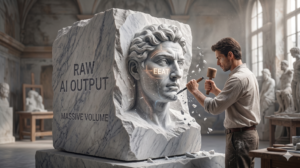
Picture AI as a massive, rough block of marble. It gives you the bulk, the volume, the vague outline of an idea. But the human editor is the sculptor. We’re the ones bringing the chisel, hacking away the fluff, refining the sharp edges, and breathing actual life into the stone. Without the marble, you’re just chipping at thin air. But without the sculptor? It’s just a heavy, useless rock. We have to become master sculptors of synthetic text.
Establishing the Baseline: The 80/20 Rule of AI and Human SEO
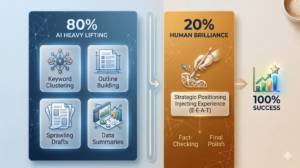
Over the last few years of assembling content teams, I’ve noticed a pattern. The most lucrative, penalty-proof workflow leans on a strict 80/20 rule. But hold on – it’s probably not the 80/20 you’re imagining. I’m talking about 80% AI heavy lifting, paired with 20% pure human brilliance.
Let the machine handle the 80% that makes you want to bang your head against the desk. The tedious stuff. Keyword clustering. Building sprawling outlines. Staring down the terrifying blank page. Let it draft those basic foundational paragraphs, summarize dry data points, and spit out meta description options. We use the bot for raw velocity.
But the human? The human editor needs to obsess over that final 20%. Because that slice is what actually moves the needle for rankings and revenue. That 20% is strategic positioning. It’s dropping in proprietary data and deeply personal anecdotes (there’s your ‘Experience’ in E-E-A-T). It’s hunting down and fixing AI hallucinations. It’s twisting the tone until it perfectly matches your brand, tweaking the formatting so it doesn’t hurt the eyes, and aligning the whole piece with what the searcher actually wants. That 20% of human sweat is entirely responsible for 100% of the page’s success.
Phase 1: Engineering the Perfect AI Prompt for SEO
How well your editing phase goes relies entirely on the raw draft you generate. Feed the machine garbage prompts? You’ll burn hours trying to salvage a fundamentally broken mess. I’ve learned the hard way: you have to be wildly prescriptive and hyper-strategic before the AI spits out a single syllable.
Typing “Write a 1500-word SEO article about dog training” is a recipe for instant mediocrity. Instead, architect prompts that box the AI into incredibly strict parameters. I always kick things off by establishing the persona, the target audience, and the exact search intent. I’ll tell the bot, “Act as a grumpy but brilliant canine behaviorist with 20 years in the trenches.” Then, I define the reader (“Overwhelmed, sleep-deprived first-time puppy owners”). I hand over the primary and secondary keywords, but I explicitly threaten the AI not to keyword-stuff.
Crucially, I dictate the skeleton. I feed it the exact H2s and H3s I want, pulled straight from my own manual SERP analysis. I outright ban robotic, soul-crushing transition words like “Furthermore,” “Moreover,” and “In conclusion.” By baking the SEO strategy directly into the prompt, the first draft comes out 60% baked. That drastically lightens the cognitive load on my human editors, letting them focus on high-level polish instead of doing structural CPR.
The most successful SEO strategies of the next decade won’t be defined by who uses AI the most, but by who edits AI the best. The algorithm is learning to spot the mathematical predictability of language models; your human editors are the only firewall you have against obsolescence.
Phase 2: The Human Editing Framework (The CRAFT Method)
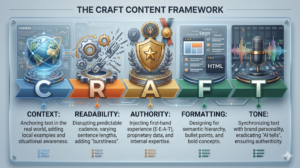
Draft in hand, the real heavy lifting kicks off. Over years of trial and error, I developed a proprietary editing framework meant to rip the robotic stiffness out of AI text and turn it into high-ranking, human-first gold. I call it the CRAFT method. If you seriously want to master the AI-human hybrid model, you need to hardwire this exact methodology into your editorial team’s brains.
CRAFT. Context, Readability, Authority, Formatting, and Tone. Every single piece of AI-generated content has to survive this five-lens gauntlet before it ever hits the “Publish” button. Let’s break down exactly how it works.
C – Context: Injecting the Human World
AI lives in a dark, isolated box. It doesn’t know if it’s raining outside. It can’t feel the economic pinch your audience is stressing over, and it totally misses the weird, subtle inside jokes of your specific niche. Our very first job as editors? Anchor the text in the real world. We have to inject context.
I am constantly hunting for spots to drop in hyper-local examples, recent news snippets, or industry quirks. It signals to the reader and to Google’s crawlers that a living, breathing human is at the wheel. If the AI spits out some generic fluff about “supply chain issues,” I’ll rewrite it to call out the specific port strikes that derailed shipping last Tuesday. I’ll add a line about how that exact event is eating into the margins of the mom-and-pop shops we’re writing for. Context is the ultimate antidote to AI blandness. It shows a situational awareness that language models simply cannot fake.
R – Readability: Breaking the AI Cadence
Read enough ChatGPT output, and you’ll start hearing a distinct, maddening rhythm in your sleep. It’s a droning, predictable hum. AI absolutely loves sentences that are exactly the same length. It adores the passive voice. It has a weird fetish for starting every paragraph with a clunky introductory clause. This rhythm isn’t just a snooze-fest for the reader. I’d bet my life that search engines are actively using rhythm analysis things like perplexity and burstiness to flag and nuke synthetic text.
To fight back, we have to violently disrupt that cadence. We need “burstiness.” We need chaos. That means purposely scrambling sentence lengths. I’ll take a bloated, winding AI sentence and chop it into three aggressive, punchy ones. Then? I’ll follow it up with a sprawling, elegantly complex thought. Ask rhetorical questions. Use fragments. Break the rigid grammatical rules the bot was programmed to worship, because real human speech is wonderfully messy. Read the draft out loud. If it sounds like a cyborg reading a manual, tear it down and rebuild the beat.
A – Authority: The E-E-A-T Imperative
Out of everything in this guide, this might be the absolute dealbreaker. Like I said before, Google is practically begging to reward Experience, Expertise, Authoritativeness, and Trustworthiness. An AI can’t conjure E-E-A-T out of thin air. It can only mimic it. We have to manually force it into the copy.
When I’m tearing through an AI draft, I’m actively looking for gaps to cram in first-hand experience. I’ll weave in lines like, “When we stress-tested this exact tactic with our enterprise clients last Q4…” or “After ten years of auditing toxic backlink profiles, here’s what I noticed…” You absolutely must prop up flimsy AI claims with hard, proprietary data, fresh research, or direct quotes from your internal experts. And for the love of rankings, fact-check relentlessly. AI hallucinates. It fabricates statistics, invents fake URLs, and completely botches complex theories. One published hallucination can permanently torch your brand’s credibility. Verify everything.
F – Formatting: Designing for the Scanner
Left to its own devices, AI is atrocious at web formatting. It loves puking out massive, intimidating walls of gray text. But decades of UX research tell us a harsh truth: people don’t read online. They skim. They scan. If a visitor hits your page, sees a monolithic block of text, and immediately bounces back to the search results, Google notices. That negative user signal will crater your rankings, even if the words themselves are pure poetry.
Human editors have to step in and ruthlessly carve up the text. I force my team to convert comma-heavy sentences into crisp bullet points. We bold crucial concepts so a scanner can absorb the core message in under ten seconds. We drop in custom graphics, bold call-out boxes, and data charts to give the eyes a break. And we strictly enforce semantic HTML hierarchy (H2s, H3s, H4s) that actually makes logical sense, guiding both the frantic reader and the Googlebot crawler.
T – Tone: Eradicating the Machine Voice
Finally, we have to sync the text with the brand’s actual personality. AI’s default setting is sickeningly polite, hyper-enthusiastic, and sterile. It leans on words like “vital,” “crucial,” “delve,” “tapestry,” and “navigating the landscape” until you want to scream. We call these “AI tells.”
Editors need to go on a ruthless search-and-destroy mission to eradicate these words. Swap them out for the slang, the colloquialisms, and the gritty industry jargon your buyers actually use. If your brand is snarky and contrarian, you have to rewrite the bot’s polite suggestions to be punchy and provocative. If you’re publishing a peer-reviewed academic journal, strip out the AI fluff and lock in strict, objective phrasing. Tone is your brand’s fingerprint. You absolutely cannot outsource it to a server farm.
The SEO Integration: Optimizing What the AI Missed
CRAFT method aside, this whole balancing act requires serious, technical on-page SEO chops. Sure, you can feed an AI tool a list of keywords. But they are notoriously terrible at semantic SEO – the art of optimizing for broad topics and underlying entities rather than just spamming exact-match phrases. Left unmonitored, an LLM will just awkwardly stuff keywords until the text reads like a 2010 spam blog.
The human has to take the reins as the chief SEO strategist. We run the draft through tools to check TF-IDF (Term Frequency-Inverse Document Frequency) and spot glaring entity gaps. We organically thread in secondary keywords, LSI terms, and related concepts the machine totally missed. We make sure the primary keyword is sitting pretty in the title, URL slug, meta description, and the opening paragraph—but we do it so smoothly the reader never notices. Finally, we manually hardcode internal links to our pillar pages using smart anchor text. AI simply can’t do that accurately without a map of your entire site architecture.
Overcoming the “Good Enough” Trap
The most lethal trap I see agencies fall into with AI generation? Settling for “good enough.” The bot spits out a draft. It’s grammatically flawless, mostly on-topic, and flows okay. The burnt-out marketer skims it, shrugs, mutters “Well, it’s not terrible,” and hits publish. We have to violently reject this mindset.
In today’s hyper-competitive SEO bloodbath, “good enough” means you are invisible. Google’s index is already choking on “good enough.” To snag a spot on page one, your content has to be a masterpiece. It needs to be the undisputed best resource on the internet for that specific search. When you edit AI, your benchmark can’t be, “Did the robot write a decent post?” Your benchmark has to be, “Did we just elevate this draft so insanely well that it undeniably crushes the top three results on Google?” If you hesitate to answer yes, get back to editing.
Scaling the Hybrid Workflow: Building Your SOP
To actually scale this hybrid magic, flying by the seat of your pants won’t cut it. You need ironclad Standard Operating Procedures (SOPs). I highly recommend splitting your content team into two camps: Prompters (the AI Directors) and Editors. The Prompter handles the keyword research, SERP stalking, and engineering the intricate prompts that spawn the first draft. They are the master architects.
The Editor takes that raw clay and runs it through the CRAFT framework. They are the polishers, the fact-checkers, the cynics. By keeping these roles totally separate, you stop the person who generated the text from falling in love with it and becoming blind to its glaring flaws. The Editor needs to attack the draft with absolute skepticism. Honestly, I even push for a “blind review” system. The final SEO manager shouldn’t know which paragraphs are AI and which are human. If they can easily spot the machine’s work, the Editor failed the assignment.
The Future of Search: SGE and the Premium on Human Insight
We need to look at the horizon. Google’s Search Generative Experience (SGE) and AI Overviews are completely rewriting how people use search engines. Google is perfectly happy using its own AI to summarize answers right at the top of the screen. If your article is just a bland recap of basic facts, Google has absolutely zero incentive to send traffic to your site. Its own bot can do that for free.
That is exactly why this heavily opinionated, deeply human, experience-first hybrid model is your only defense. It future-proofs your SEO. Google’s AI cannot legally or logically generate a highly contested, unique opinion. It can’t pull a raw case study from your private client vault. It can’t tell a vulnerable story about a massive marketing failure and the hard lessons learned. When we let AI do the grunt work of drafting, but rely on humans to inject fierce originality, we create “un-summarizable” content. We force the user to click our link because the real value is our unique human perspective, not the raw data.
The Psychological Shift for Writers and Marketers
Let’s talk about the elephant in the room: the mental toll this is taking on writers. A lot of incredibly talented creatives feel a target on their backs. They feel their life’s work is being commoditized into a cheap software subscription. I totally get the panic. But we have to flip the script. AI isn’t here to assassinate great writers. It’s here to murder mediocre writing.
By offloading the soul-crushing grunt work defining basic terms, building structural outlines we actually liberate our human talent. We free them up to do what machines can’t: think critically, scheme strategically, and punch the reader right in the emotions. We are upgrading the creator from a simple typist to a high-level strategist and subject matter expert. Leaning into this hybrid workflow isn’t waving a white flag to the robots. It’s the next evolution of our craft.
Measuring the ROI of the Hybrid Approach
Let’s talk brass tacks. At the end of the day, SEO is a financial investment. I’ve aggressively tracked the ROI across three buckets: purely human content, purely AI content, and hybrid content. I’ve done this across massive portfolios. The data is jaw-dropping, and it 100% validates this entire strategy.
Purely human content? Beautiful quality, but brutally expensive and agonizingly slow. The ROI is there, but the payback period takes forever. Purely AI content? Costs pennies and publishes instantly. But the quality is absolute garbage. The ROI is almost universally negative because the pages don’t rank, nobody converts, and it frequently triggers algorithmic penalties that nuke the domain’s underlying value.
But the hybrid model – that 80% AI grunt work paired with 20% ruthless human polish hits the absolute bullseye. We slash the cost-per-article by 50% to 70% compared to manual writing, while matching (or honestly, beating) the quality and ranking power. The sheer speed lets us dominate entire topic clusters in weeks, not months. Building topical authority becomes a breeze. Paying elite editors top dollar to aggressively refine AI drafts is, without a doubt, the highest-yielding investment in modern SEO.
The Ethical Imperative of Truth in Content
Forget about ROI and rankings for a second. We have a massive ethical duty as publishers. We are pumping information into the real world. When someone Googles for medical symptoms, financial planning, or legal advice (those critical YMYL topics), they are making choices that alter their lives. Letting an unchecked algorithm generate that advice isn’t just lazy SEO. It is dangerously irresponsible.
The human editor is the ultimate ethical safety net. We have to own every single syllable we publish. We use the AI-human hybrid model because we actually respect the people reading our stuff. We leverage the machine to get answers to the reader faster, but we rely on the human to ensure those answers are accurate, safe, and respectful. Trust is the only real currency on the internet. Let an AI hallucination destroy it, and you will almost never get it back.
Conclusion: The Path Forward
The golden age of “easy” SEO is dead and buried. The days of paying pennies for 500-word fluff pieces are gone. And that wild, chaotic window where you could spam the web with raw ChatGPT output? It’s slamming shut as we speak. We are crashing headfirst into an era defined by extreme quality and raw authenticity, which, ironically, was triggered by the explosion of artificial intelligence.
To actually survive the carnage, you have to master the hybrid workflow. You have to learn how to engineer prompts with surgical precision, edit with zero mercy, and forcefully inject your own messy humanity into synthetic text. Use AI for leverage, not as a cheap substitute for actual expertise. If you can nail this balance if you can fuse the limitless scale of the machine with the irreplaceable soul of a human you won’t just survive the AI wave. You will absolutely dominate the search results for the next decade.
Frequently Asked Questions
What is the biggest mistake people make when using AI for SEO content?
The single most fatal error is treating the AI like an independent journalist instead of a junior drafting assistant. So many site owners blast out a one-sentence prompt, grab the output, and hit publish without a shred of human review, fact-checking, or tone tweaking. What happens? You get a sea of generic, repetitive gobbledygook that totally lacks E-E-A-T (Experience, Expertise, Authoritativeness, and Trust). It’s basically begging Google’s Helpful Content system to penalize your site.
How much time should a human editor spend on an AI-generated draft?
It definitely fluctuates depending on how complex the topic is, but a solid baseline is spending about 30% to 50% of the time it would have taken to write from scratch. If a 1,500-word beast used to take you 4 hours of manual labor, expect to spend 1.5 to 2 hours heavily editing, fact-checking, and injecting life into the AI draft. That’s what it takes to hit premium SEO standards.
Can Google detect AI-generated content, and will they penalize me for it?
Google has actually gone on record saying they don’t penalize content just because a machine wrote it. They penalize content that is spammy, useless, or adds zero value. The catch? Unedited AI content almost always lands squarely in that “useless” bucket because it brings zero original insight or information gain to the table. Google’s algorithms are frighteningly good at spotting the predictable rhythms, lack of burstiness, and sterile phrasing that raw AI spits out.
How do I inject E-E-A-T into an article that an AI wrote?
You bake in E-E-A-T during your aggressive human editing phase by dropping in things a robot simply can’t experience. Think first-person war stories, proprietary data your company gathered, or spicy quotes from vetted subject matter experts. You need to link out to heavy-hitting authoritative sources and make sure the author bio actually reflects real-world expertise. You’re basically transforming a robotic summary into a deeply perspective-driven narrative.
Is it necessary to use premium AI tools, or is the free version of ChatGPT enough for SEO?
Sure, you can scrape together basic outlines with the free models. But if you’re serious about SEO, you need to shell out for the premium versions (like GPT-4, Claude 3 Opus, etc.) or dedicated AI writing software. The paid models hallucinate way less, actually follow complex formatting rules, and understand the subtle nuances of human language far better. Just remember: even if you drop thousands on enterprise AI, it still desperately needs a human editor to actually rank.