



Picture this: your hands are caked in sticky dough, and you’re hollering across the kitchen to ask a glowing cylinder how many ounces make a cup. Sound familiar? Guilty as charged. Or maybe you’ve barked at your dashboard while merging on the highway, desperate for a decent espresso nearby. These mundane, blink-and-you-miss-it moments actually prove something massive. Voice search isn’t some fringe novelty anymore, it’s baked right into our daily survival. Typing out clunky phrases? That’s old school. Now, we just chat with our tech.
If you build websites, write content, or push products online, ignoring this pivot is digital suicide. I remember the exact moment the lightbulb flipped on for me: seeing Alexa and Google Home units invade every living room on the block. Traditional SEO? Suddenly, it felt woefully inadequate. Snagging that coveted spot where a virtual assistant literally reads your words out loud requires a total content overhaul. This isn’t some sci-fi fantasy waiting in the wings. It’s here. And honestly? I’m pumped to walk you through exactly how to rig your site to dominate these smart speaker queries.
Understanding How We Speak vs. How We Type
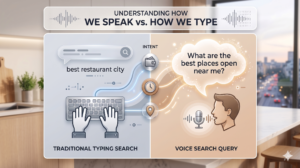
Let’s kick things off by dissecting the bizarre gap between our keyboards and our vocal cords. If I’m hunched over a laptop craving pasta, my fingers tap out something ruthlessly caveman-like: “best Italian restaurant Chicago.” But if I’m asking my smart speaker? Suddenly, I’m a polite conversationalist. I’ll say, “Hey, what are the best Italian joints open near me right now?”
See the leap? Spoken searches stretch out. They breathe. They morph into full-fledged questions littered with who, what, where, when, why, and how. Chasing those staccato, high-volume keywords won’t cut it anymore if you want to win the audio game. You’ve got to pivot toward conversational long-tail phrases. Anticipate the actual, messy, human questions your crowd is blurting out into the ether.
My advice? Grab a coffee with your team and hash out the literal questions customers ask you over the phone. Don’t polish them. Keep the raw phrasing. Fire up some question-based keyword tools to dig up those hyper-specific long-tail gems. When your content echoes the organic rhythm of human speech, you’re laying down the ultimate foundation for voice search dominance.
Step 1: Winning the Featured Snippet (Position Zero)

Here’s a wildly unfair truth about voice search: smart speakers play favorites. Big time. Type a question into Google, and you get a buffet of blue links. Ask a smart speaker, and it gives you exactly one answer. Usually, it yanks this golden response straight from the “Featured Snippet” – that coveted Position Zero hovering at the very top of the results page. If you want a robot voice to read your expertise to the masses, claiming that snippet isn’t optional. It’s mandatory.
So, how do you snag the crown? Formatting. Period. Search algorithms drool over crisp, ruthlessly structured answers. Whenever I write a piece hoping to steal Position Zero, I lean heavily on the “Inverted Pyramid” strategy. Boom, hit them with a fiercely direct, no-fluff answer right out of the gate. I try to cage this initial response in a tight 40 to 50 words. Why? Because it’s the exact sweet spot. It gives the smart speaker enough meat to sound helpful without putting the listener in a coma.
Once that punchy intro is out of the way, I let the rest of the page breathe. That’s where you unpack the details, layer in context, and sprinkle your examples. It’s a win-win. The algorithm gets its bite-sized audio snippet, and actual human visitors get the deep-dive, high-caliber content they clicked for.
To win in voice search, you must stop thinking like a traditional marketer and start thinking like a helpful friend. Smart speakers don’t want a list of blue links; they want a single, definitive, and highly accurate answer delivered in natural language.
Step 2: Structuring Your Content Like a Conversation
Optimizing for voice means you are, at your core, scripting a dialogue. Your content flow has to mimic the casual ping-pong of a real chat. Honestly, the absolute best cheat code I’ve found for this is relentlessly injecting Frequently Asked Questions (FAQ) sections into my articles and landing pages.
Look at it through the eyes of a web crawler. An FAQ block is essentially a voice search simulator. You’ve got a natural-language question stacked right on top of a punchy, authoritative answer. Handing search engines this pre-packaged format is basically serving them voice-ready content on a silver platter.
Whenever I slap together an FAQ, I aggressively use H3 tags for the questions themselves. This creates a rigid, idiot-proof hierarchy so the bots know exactly what the prompt is and can instantly pair it with the text underneath. Tone matters, too. Ditch the stiff corporate jargon. Write like you’re explaining a concept to a buddy at a dive bar. That breezy, conversational vibe is exactly what voice assistants are hunting for.
Step 3: Mastering Local SEO for Voice Queries
Got a brick-and-mortar shop? Listen up. Local SEO isn’t just a piece of the voice search puzzle; it’s practically the entire board. A staggering chunk of voice queries are aggressively local. We constantly bark things like, “Where’s the nearest taco truck?” or “Is the hardware store still open?” at our phones. These aren’t idle curiosities. They are blazing-high-intent queries. If someone is asking for store hours, they’ve already got their wallet out.
To intercept that hyper-valuable foot traffic, your local business listings need to be immaculate. Claim your profiles across every directory that matters. Check your NAP (Name, Address, Phone number) data until you go cross-eyed. Seriously. Even a goofy typo in a street abbreviation (“St.” vs. “Street”) can send a search engine into a tailspin, ensuring a smart speaker recommends your competitor instead of you.
Beyond the directories, weave local flavor directly into your site’s copy. Name-drop the quirky neighborhoods you service. Mention the landmark down the street. Use the slang actual locals use. When a smart speaker scrambles to find a nearby answer, it relies on intense geographic signals. Hyper-localizing your text practically paints a giant bullseye on your roof for the algorithms.
Step 4: Technical SEO and Schema Markup

Brilliant writing is useless if your website’s engine is sputtering. Voice search engines ruthlessly prioritize sites that are fast, technically flawless, and mobile-ready. Think about it: when someone asks Alexa a question, they expect an answer now. Not in five seconds. If your page drags its feet, the algorithm will skip you without a second thought and pull data from a snappier rival. Compress your images. Fix your caching. Make sure your server response times are terrifyingly fast.
But speed is just the baseline. Want a secret weapon? Schema Markup. It sounds intimidating, but it’s basically just structured data – a little snippet of code that translates your human words into a dialect that machines instantly understand.
For the voice arena, two specific flavors of schema are pure gold. First is FAQ Schema, which loudly flags a section of text, telling the bot, “Hey! This is a list of exact questions and answers!” Then there’s Speakable Schema. It’s newer, but it’s designed specifically to highlight the juiciest, most audio-friendly chunks of an article for text-to-speech playback. Injecting this code is like rolling out a red carpet for crawlers, practically begging them to siphon your content for voice answers.
Step 5: The Importance of Mobile-First Optimization
You simply can’t untangle voice search from mobile culture. Sure, the kitchen smart speaker gets all the glossy magazine coverage, but the lion’s share of voice queries are still muttered into iPhones and Androids via Siri, Google Assistant, or Bixby. If your site looks like garbage on a smartphone, you’re dead in the water.
A mobile-first mindset isn’t a buzzword; it’s a survival tactic. Can people read your font without pinching and zooming? Are your buttons fat enough for a clumsy thumb to tap? Is the menu a nightmare? Search engines index the mobile version of your site first. If that experience is clunky, your odds of ranking for voice or literally any search at all will totally crater.
Measuring Your Voice Search Success
Here’s the frustrating part: tracking voice search isn’t exactly a walk in the park. Most analytics dashboards stubbornly refuse to separate a spoken query from a typed one. But don’t panic. You aren’t flying entirely blind.
I usually comb through my search console data, hunting for impressions on bizarrely long, conversational queries. If I suddenly spot a spike in traffic from weird, full-sentence questions, that’s a massive red flag (the good kind!) that my voice optimization is catching fire. On top of that, watch your featured snippets like a hawk. Since Position Zero drives almost all voice answers, claiming those top-tier snippet spots is the absolute best yardstick we have right now for voice visibility.
Embracing the Conversational Future
Overhauling your site for smart speakers can feel like a mammoth undertaking, I know. But strip away the tech jargon, and the core philosophy is actually incredibly simple: just give people the most direct, painfully helpful answers possible. By swapping our “typing” brains for our “talking” brains, we end up creating content that feels wonderfully human, accessible, and deeply authoritative.
We’re hurtling toward a reality where our gadgets act less like tools and more like chatty assistants. If you take the time to structure your answers, dial in your technical SEO, and fiercely protect your local search footprint, you won’t just survive this voice-first wave – you’ll ride it. So lean into the shift. Start answering your audience’s questions out loud, and watch your brand’s digital footprint explode right alongside the smart speaker revolution.
Frequently Asked Questions
How long should my answers be for voice search optimization?
When you’re trying to bait a voice search algorithm, brevity is everything. I aggressively push for direct answers sitting squarely in the 40 to 50-word range. Why? It’s the Goldilocks zone for text-to-speech. It dishes out enough value to be useful without rambling on and annoying the user. By all means, go wild and expand on the topic in the following paragraphs, but keep that initial trigger response tight, punchy, and mercilessly brief.
Does voice search optimization work for B2B companies?
100% yes! It’s super easy to write off voice search as a gimmick for finding cheap pizza or checking tomorrow’s weather, but B2B pros are leaning on it heavily, too. Executives and founders constantly bark at their phones while commuting, trying to define obscure industry jargon or hunt down software vendors. If your B2B brand can clearly and conversationally answer those niche questions, you instantly position yourself as a heavyweight thought leader in the audio space.
Which search engines power the different smart speakers?
Knowing where these bots fetch their data is half the battle. Google Assistant (living in Androids and Google Home hubs) obviously yanks its data straight from Google. Amazon’s Alexa, however, is a bit of a wildcard – it leans on Bing for general web answers, but cross-references databases like Yelp to dish out local business info. Meanwhile, Apple’s Siri juggles Apple Maps for local queries and Google for broader questions. A solid Google SEO strategy covers most of your bases, but ignoring your Bing Webmaster or Yelp profiles is a rookie mistake.
Do I need a completely separate website for voice search?
Nope. Not at all. Voice search optimization isn’t about building a parallel universe; it’s just the next logical mutation of normal SEO. Your goal is simply to make the digital real estate you already own friendlier to both wandering humans and robotic crawlers. By weaving in chatty keywords, slapping up a few FAQs, boosting your load times, and sprinkling in some schema markup, you’re just future-proofing the website you already have.