



Ever found yourself glaring at a flatlined analytics dashboard, wondering why pouring your blood, sweat, and tears into top-notch content isn’t moving the needle? Trust me, you’re not walking that road alone. A handful of years back, our digital marketing squad hit exactly that wall of frustration. We’d partnered up with EcoHike, a phenomenal, mid-sized family operation selling outdoor gear. They boasted top-tier merchandise, killer customer support, and a downright infectious love for the wilderness. The catch? To Google, they basically didn’t exist.
Taking the reins of their SEO, we quickly spotted the wreckage left by their former agency. The old playbook? Blindly chasing “head terms.” We’re talking absolute behemoths like “hiking boots,” “camping tents,” and “outdoor gear.” Sure, those phrases look tantalizing on a spreadsheet. Hundreds of thousands of monthly searches. The underlying math feels bulletproof: siphon off even a tiny sliver of that search volume, and you’ll be drowning in revenue. Right?
Dead wrong. Squaring off for “hiking boots” meant locking horns with multi-billion-dollar retail titans, sprawling affiliate networks, and legacy brands. EcoHike was bringing a butter knife to a bazooka fight. On the rare occasion we clawed our way to the shadowy depths of page one for a moderately broad keyword, the resulting traffic was absolute garbage. Bounce rates went through the roof. Conversions? A pitiful 0.4%. Folks searching for “hiking boots” were merely window shopping, hunting for aesthetics, sizing up brands, or just killing time. Their wallets were firmly shut.
A radical pivot wasn’t just a good idea; it was survival. We had to stop fighting Goliath on his home turf. It was time to rewrite the rules. That exact afternoon, we pushed all our chips into long-tail keyword research. We hunted exclusively for those quirky, high-converting, low-competition phrases fueled by intense, specific search intent. This case study breaks down our exact playbook and shows how you can hijack this wonderfully pragmatic approach for your own brand.
Understanding the Magic of the Long Tail
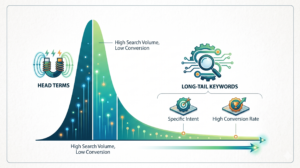
Before pulling back the curtain on the actual mechanics, let’s demystify how we pitched the “long tail” to EcoHike’s brass. A common misconception equates “long-tail” with a chunky phrase that reads like a full sentence. Sure, they’re often wordy, but the “long tail” actually describes a statistical demand curve. Plot every internet search on a graph: a tiny cluster of broad keywords hogs the massive search volumes (the “head”), while millions of weird, hyper-specific queries barely register a blip individually. Stretched out infinitely to the right, these countless oddball searches form that famous “long tail.”
Here was the lightbulb moment for our client: head terms capture roughly 30% of global search traffic. The long tail? That swallows the remaining 70%. Better yet, as a search query grows longer and infinitely more specific, the user’s underlying goal sharpens into vivid focus. Suddenly, their likelihood to whip out a credit card goes parabolic.
Consider your own digital footprint. Punch “shoes” into Google, and what are you actually demanding? A Wikipedia history lesson? A nearby boutique? Stock photos of stilettos? The algorithm is essentially throwing darts in the dark. But type in “men’s waterproof trail running shoes size 11,” and your mission is glaringly obvious. Your wallet is practically sitting on the keyboard. You’re ready to buy right this second; you just need a cash register. We decided EcoHike was going to be that cash register.
Targeting the long tail isn’t about hoarding hollow vanity metrics; it’s about intercepting a mindset. These users have exhausted their research phase. They are standing in the hallway, jiggling handles, desperate for the right door to open. Match their precise intent, and your website becomes that open door.
Step 1: Shifting Our Brainstorming from Products to Problems
The first real hurdle? Flipping our brainstorming process entirely on its head. We stopped treating EcoHike’s inventory as a sterile list of SKUs and started viewing it as a toolbox for incredibly niche dilemmas. We crammed EcoHike’s customer service reps, sales veterans, and our own SEO nerds into a cramped conference room. Fueled by an irresponsible amount of black coffee, we started interrogating them.
The prompts were simple: What bizarrely specific questions do buyers relentlessly ask before swiping a card? What obscure, aggravating problems do your tents and boots actually solve?
Bypassing a generic term like “tents,” we struck gold with phrases like “how to keep a tent warm in winter camping” and “best lightweight tent for hiking with a large dog.” Instead of battling for “hiking backpacks,” we unearthed “backpacks that don’t cause lower back pain” and the incredibly specific “waterproof daypacks for camera gear.”
Zeroing in on customer pain points handed us a towering stack of seed ideas. They weren’t polished keywords just yet. But they provided the thematic scaffolding we desperately needed to launch our deep-dive analytics.
Step 2: Mining for Low-Competition Gold
Armed with an arsenal of customer grievances, we needed to validate our hunches. How were real people actually phrasing these headaches in Google? We craved solid search volume coupled with laughably weak competition. Getting there required a cocktail of premium SEO software and some gritty, boots-on-the-ground sleuthing.
First, we exploited Google’s autosuggest. We’d feed the search bar a prompt like “best hiking boots for…” and watch the algorithm spill its secrets. Out popped gems like “best hiking boots for wide feet and high arches” or “best hiking boots for plantar fasciitis.” Diving into the “People Also Ask” boxes and related searches at the bottom of the SERPs uncovered an absolute goldmine of conversational, long-tail questions that actual humans were desperately asking.
Then, things got wonderfully granular. We lurked in community forums. We burned hours scouring outdoor enthusiast message boards, ultralight backpacking subreddits, and niche Facebook groups for weekend hikers. We absorbed their slang. We realized hardcore trekkers almost never typed “camping backpacks.” Instead, they obsessed over “40L ultralight frameless packs.” By mimicking the community’s native tongue, we bagged highly lucrative keywords that our expensive, generic SEO tools had completely glossed over.
Step 3: The Crucial Alignment of Search Intent

Unearthing a low-competition, long-tail keyword is, frankly, only half the war. The other half? Matching your content flawlessly to the user’s Search Intent. Honestly, this is the crux of the entire campaign. Get the intent wrong, and even the most brilliant keyword will flatline.
We ruthlessly sorted every single keyword we discovered into four distinct intent buckets:
- Informational Intent: The user is hungry for knowledge. (Think: “How to waterproof leather hiking boots”). For these, we mapped out meaty, step-by-step tutorials and deeply researched blog posts.
- Navigational Intent: The user just wants to find a specific destination. (e.g., “EcoHike return policy”). We made sure these utility pages were dead-simple to locate.
- Commercial Investigation: The searcher is itching to buy, but they’re weighing their options. (Like, “Merrell Moab vs Salomon X Ultra 4”). We tackled these with brutally honest comparison breakdowns and comprehensive round-up reviews.
- Transactional Intent: The credit card is practically touching the screen. (e.g., “Buy women’s insulated winter hiking boots size 8”). These golden queries were wired directly to heavily optimized product pages and hyper-specific category filters.
The autopsy of EcoHike’s old strategy revealed a glaring flaw: they were trying to rank transactional product pages for broad, informational queries. It was like trying to fit a square peg into a round hole. To fix the rot, we engineered a holistic ecosystem where every single keyword was perfectly married to its ideal content type.
Step 4: Executing the Content Ecosystem
Keyword map finalized. Intent buckets sorted. It was time to get our hands dirty. We attacked the product pages first. Gutting the bland, manufacturer-supplied descriptions, we organically wove our transactional long-tail keywords into the copy. We bolted robust FAQ sections onto the bottom of product pages, specifically designed to snare hyper-niche product queries.
Next up: the blog. We deployed a classic “Hub and Spoke” architecture. We’d construct a massive, authoritative guide (the hub) covering a broad concept like “Winter Camping.” From there, we spun out dozens of internal links to hyper-focused, long-tail articles (the spokes). Suddenly, we were publishing pieces like “How to prevent condensation in a single-wall tent” and “The best cold-weather sleeping pad for side sleepers.”
Because these subjects were so painstakingly narrow, our competition vanished. We didn’t have to beg for thousands of backlinks to rank. Our only mandate was to publish the single most helpful, definitive answer on the internet for that exact query. We obsessed over formatting—snappy headings, digestible bullet points, and unfiltered, real-world wisdom directly from EcoHike’s veteran gearheads.
The Results: Less Traffic, Massive Growth
We let this new ecosystem marinate for about six months, relentlessly pumping out intent-matched, long-tail content. When the day finally came to sit across from EcoHike’s founders and unpack the quarterly analytics, the data completely shattered their preconceived notions of SEO.
Glance at the top-level traffic alone, and you might have shrugged. Overall website visitors only crept up by a modest 18%. Since we’d abandoned those monstrous head terms, our raw visitor count wasn’t exploding into the stratosphere. But the metrics that actually pay the bills? Those were going supernova.
Organic bounce rates cratered by 42%. Users were clicking into our highly specific articles, discovering exactly what they needed, and sticking around to devour more content. Our pages-per-session metric simply doubled.
But the undisputed crown jewel of the campaign was the revenue. Organic search revenue skyrocketed by an absurd 215%. Let that sink in. Traffic only ticked up 18%, but the cash generated from organic search more than tripled. The secret? Qualification. A hiker Googling “best lightweight tent for hiking with a large dog” who lands on a review of three specific tents – complete with photos of muddy golden retrievers inside them – is incredibly primed to click “add to cart.” We stopped trying to boil the ocean. Instead, we went spearfishing for the perfect buyer.
By pivoting hard into long-tail keywords and obsessively catering to search intent, EcoHike mutated from an invisible, struggling retailer into a wildly profitable juggernaut in their specific niches. The grand lesson? In the treacherous waters of SEO, bigger rarely means better. Sometimes, the most lucrative move you can make is to think small, get weirdly specific, and actually help the human sitting on the other side of the glass.
Frequently Asked Questions
What exactly is a long-tail keyword?
Think of a long-tail keyword as a highly targeted, hyper-specific search query. Sure, they usually sport lower monthly search volumes, but they carry a wildly higher conversion rate compared to chunky “head” terms. While they frequently contain three or more words (like “best running shoes for flat feet”), the “long tail” moniker actually stems from their placement on the search demand curve. They represent the millions of unique, oddball searches that, when combined, make up the vast majority of all internet traffic.
Do long-tail keywords really drive enough traffic to be worth the effort?
Without a doubt. A single long-tail phrase might only scrape together 50 visitors a month. But rank for dozens or hundreds of these laser-focused terms, and that traffic aggregates into a formidable tidal wave. Better yet, because the intent behind the search is so dialed-in, those 50 visitors are exponentially more likely to buy your gear, join your mailing list, or shoot you an email than 5,000 random wanderers who searched for a vague, broad term.
How do I determine the search intent for a long-tail keyword?
The simplest hack? Type the keyword into Google yourself and ruthlessly analyze page one. If the top spots are dominated by blog posts and tutorials, the intent is purely informational. If you see wall-to-wall product listings or e-commerce category grids, it’s transactional. Your job is to mirror the format and ultimate goal of the pages that the algorithm is already choosing to reward.
Can I use long-tail keywords to optimize my homepage?
As a rule of thumb, no. Your homepage should ideally be optimized around your brand identity and your core value proposition (which usually leans toward broader phrasing). Save your long-tail ammunition for dedicated blog posts, specialized landing pages, sprawling FAQ sections, and highly specific product pages. That’s where you have the real estate to thoroughly, deeply answer the searcher’s exact question.